Sensitive content
This site contains sensitive content that includes references to sexual violence.

Wednesday 5th November 2025: A postcode lottery across the European Union (EU) is allowing child abusers to escape punishment and denying justice to survivors, a new report has revealed. Wide variations in law across EU states in time limits for prosecutions mean many abusers never face the force of the law. The report is released amid the EU process to reform Article 16 of the recast Directive (2011/93/EU) to abolish the criminal and civil statute of limitations for all child sex abuse offences.
Child sexual abuse (CSA) remains a devastating epidemic affecting 1 in 5 children across the EU. Extensive research indicates that survivors of CSA endure trauma that is often chronic, profound, and uniquely damaging with lifelong impact compared to other crimes. With the average age of disclosure at 52, many survivors are barred from seeking justice due to statutes of limitations (SOLs) expiring long before they are able to come forward.
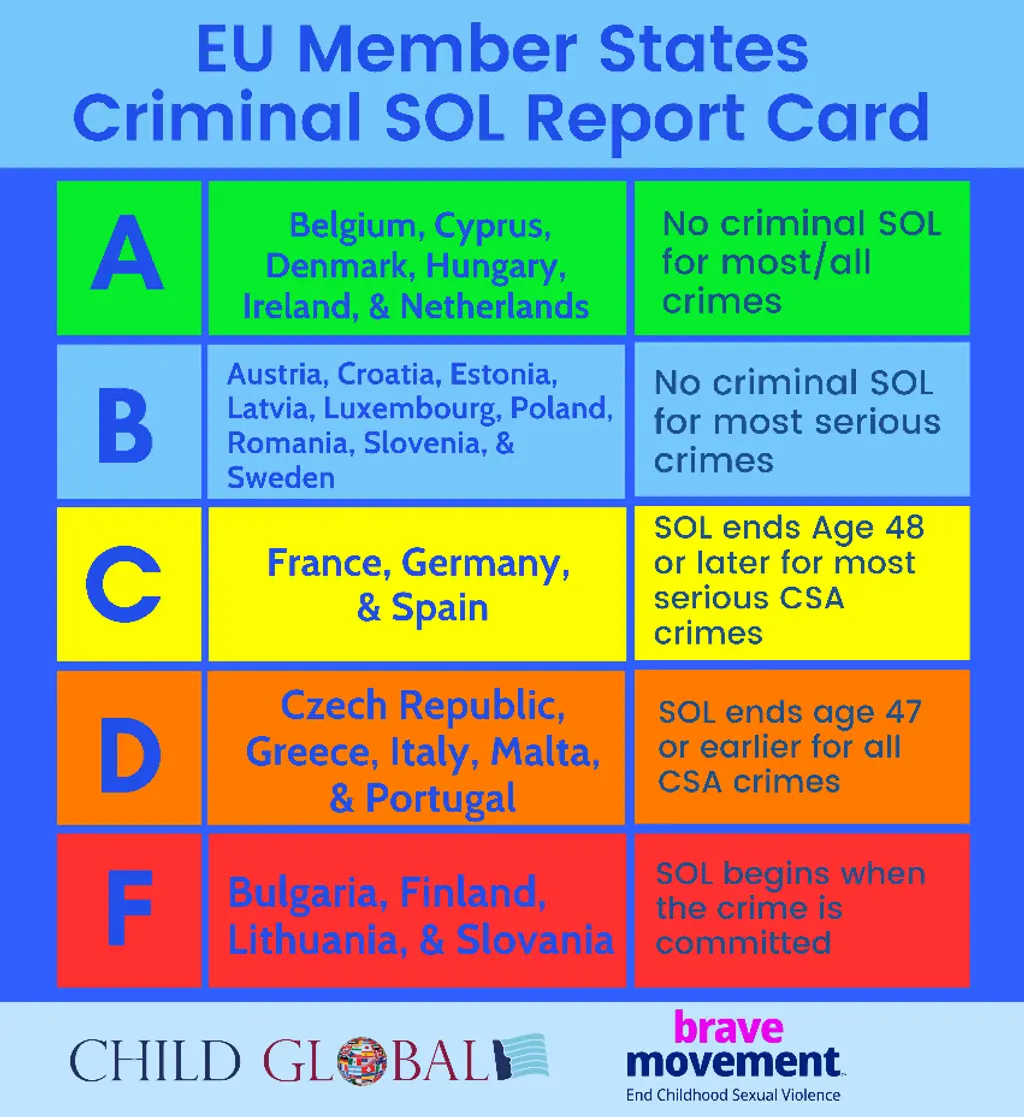
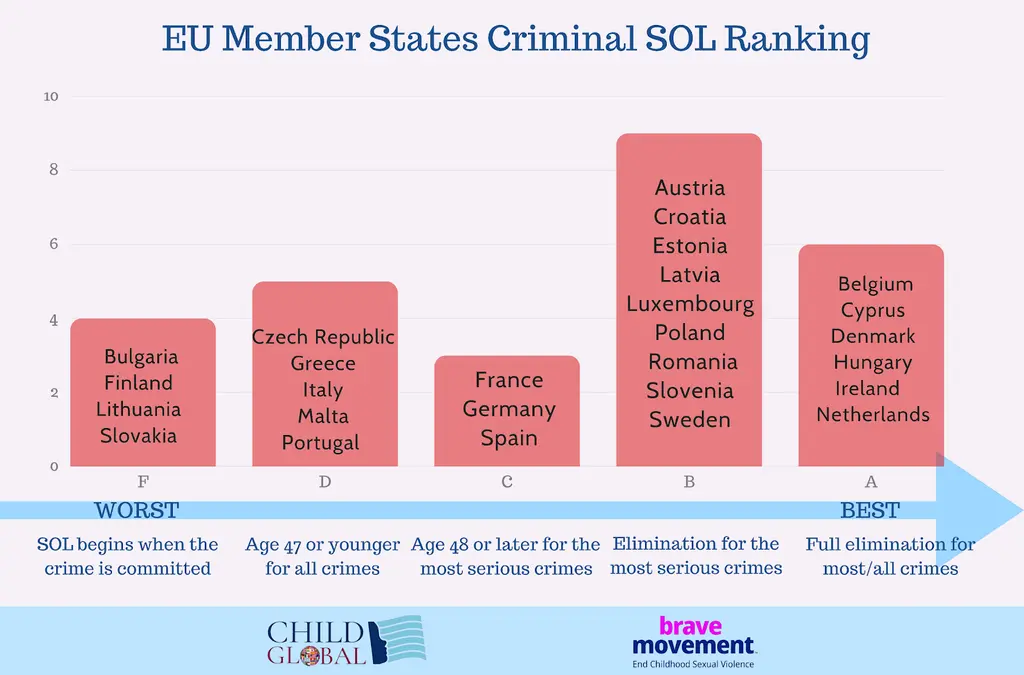
A new report from the Brave Movement and Child Global – Justice without borders: Access to justice should not be a postcode lottery – unveils an easy-to-read snapshot of each EU member state’s criminal SOL ranking. The grading provides a stark illustration that European law, as it stands, means that access to justice for CSA survivors across the EU remains uncertain. The report acts as a rallying call for the EU to act now to end the SOLs on child sexual abuse crimes.
When SOLs prevent prosecution, abusers evade punishment, remain off sex offender registries, and continue to pose risks—especially as many have exploited this legal loophole, allowing them to avoid criminal background checks and have direct access to children despite having a history of serially abusing multiple victims, sometimes over decades. Institutions like the Catholic Church have been documented transporting European offenders (who cannot be prosecuted in their home country because the limitation period has run out) to developing countries with weak or non-existent child protection laws, where they continue to prey on vulnerable children.
A call for urgent reform
Professor Marci A. Hamilton, Founder & Chief Visionary Officer, CHILD Global says, “CHILD Global is proud to stand with the Brave Movement and these brave survivors to demand justice for child sex abuse victims. Without access to justice, the survivors are sent a message that they don’t matter, and the public is deprived of learning the truth about pervasive child sex abuse. Abolition of the statutes of limitation would make EU member states global leaders in child protection.”
Miguel Angel Hurtado Calvo, Brave Movement advocate and report co-author, says, “The legal net cannot close around abusers when there are so many holes in it. If we do not address this now, we may lose the chance to give justice to survivors for another generation. We urge the EU to lead decisive reform to abolish or significantly extend the SOLs for CSA crimes across all member states. At a minimum, the updated EU Directive should establish that the limitation period does not expire before survivors reach age fifty-three, aligning with the average age of disclosure and ensuring survivors have a real opportunity to seek justice.”
Why this matters
A united EU response
Addressing this issue requires an EU-wide approach. The recent unanimous political consensus among all 27 EU countries at the Lanzarote Committee to issue an opinion that calls for the abolition or significant expansion of SOLs demonstrates a shared recognition of the urgency. Member states now have well-established legal tools to implement these reforms, whether through suspending the initiation of the limitation period until the victim reaches a certain age (as Germany and Spain have done), establishing a minimum age cap before which SOLs cannot run out (as Poland has done), or doubling/tripling normal limitation periods in CSA offences (as Italy or Slovenia have done).
A step towards excellence
The current draft EU Directive, while a positive step, must go further, aiming for the complete abolition of criminal and civil SOLs for CSA offences or, at the very least, setting the limitation period to last until survivors reach age 53. This aligns with scientific evidence, including the Adverse Childhood Experiences (ACE) study, which links long-term harm with the cumulative trauma of multiple adverse childhood experiences (i.e. child sex abuse, physical abuse, parental mental illness or substance misuse), regardless of the severity of each ACE, such as child sex abuse, individually.
A moral and legal imperative
We call on EU decision-makers to:
Protecting children and enabling access to justice for survivors must be a priority for the EU. This is not just a legal issue; it is a moral obligation to the vulnerable children of today and future generations.
Press contact
Rebecca Ladbury
[email protected]
07941 224 975
NOTES TO EDITORS
ABOUT THE EU MEMBER STATES CRIMINAL SOL´S RANKING
ABOUT CHILD GLOBAL
CHILD GLOBAL is the nonprofit think tank for children devoted to ending child abuse and neglect, and it leads the way for statute of limitations (SOL) reform in the United States and around the globe. CHILD GLOBAL engages in high-level legal and social science research and analysis to derive the best public policies to guide the formation of the best laws and policies for child protection. CHILD GLOBAL produces evidence-based solutions and information needed by policymakers, organizations, media, and society to increase child protection and the common good.
ABOUT THE BRAVE MOVEMENT
The Brave Movement is a global survivor-led initiative demanding action to end childhood sexual violence. Hosted by Together for Girls, the movement mobilises and unites survivors and allies in more than 20 countries globally to push for urgent, systemic change. Learn more at www.bravemovement.global.
ABOUT TOGETHER FOR GIRLS
Ending violence against children cannot be solved by a single actor or sector alone. Together for Girls is a global partnership working to end sexual violence against children and adolescents. Active in over 20 countries, Together for Girls unites actors that often do not work together, including national governments, United Nations entities, the private sector, civil society, and survivors. Through data and advocacy, Together for Girls drives action to break cycles of violence and ensure prevention, healing, and justice. Learn more at: www.togetherforgirls.org.